Selected researchVisual navigation
Single-image spacecraft pose estimation
Visual navigation · 2026
From eleven landmarks to a pose
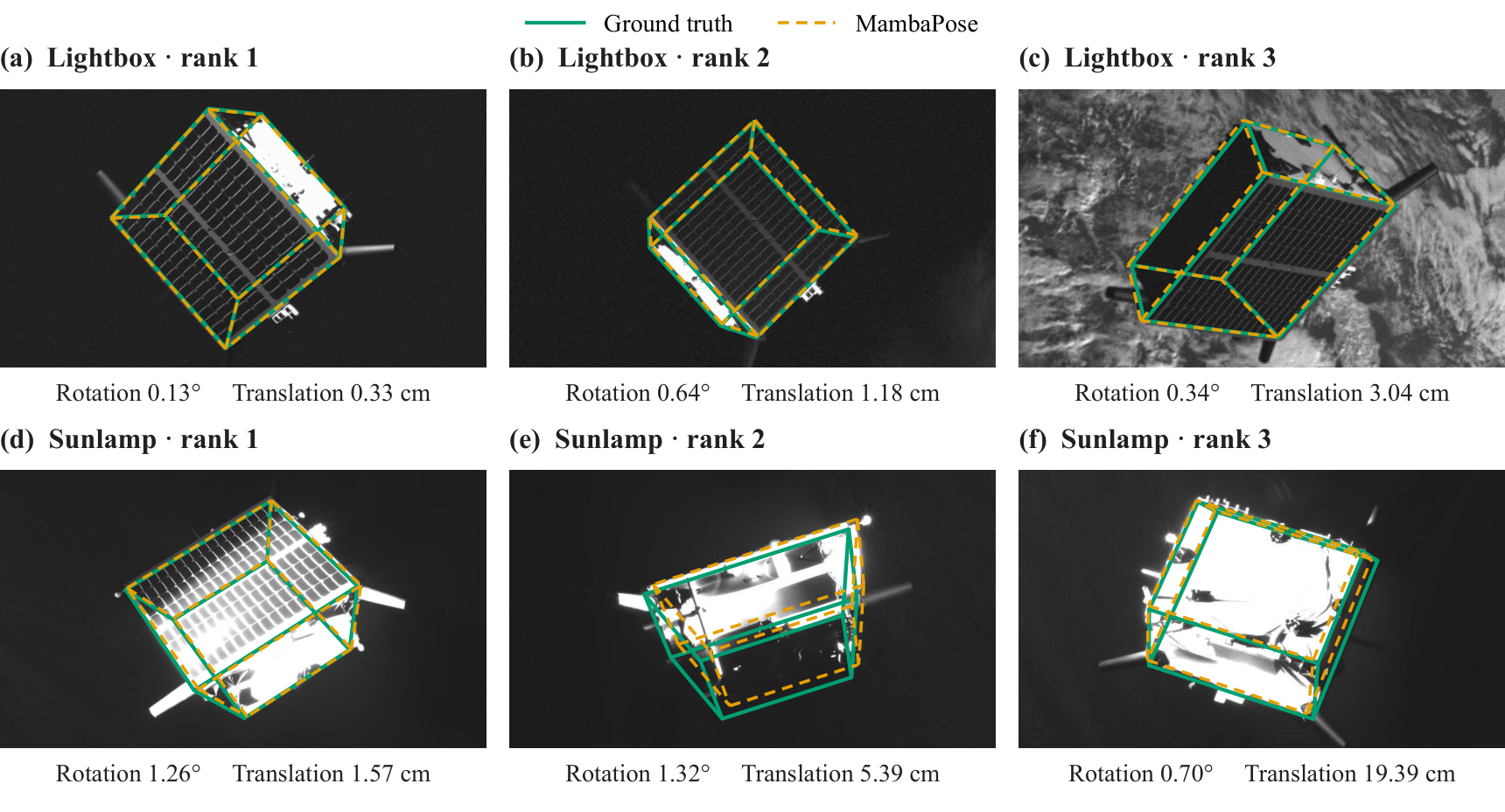
A single camera sees a flat image of a three-dimensional target. A solar panel edge can be easy to locate under diffuse light and almost disappear in glare. An error of a few pixels at one landmark can rotate the estimated spacecraft even when the rest of its outline looks right.
Our 4.82-million-parameter network predicts the image locations of eleven known spacecraft landmarks and estimates their uncertainty. A geometric solver uses their known 3D coordinates to recover position and orientation. In a follow-up experiment, we rotate the same image four ways, run all four views through the same network and map the detections back into the original image. The pose that best fits the combined observations is selected.
What changes on held-out images?
We adapted the model using labeled laboratory images and evaluated it on 2,860 held-out SPEED+ frames. The table compares one pass with four-rotation refinement using the same weights. The pose score combines rotation and relative translation errors. Lower values indicate a closer estimate.
| Lighting | Frames | One pass | Refined |
|---|---|---|---|
| Lightbox | 2,022 | 0.0634 | 0.0415 |
| Sunlamp | 838 | 0.0741 | 0.0540 |
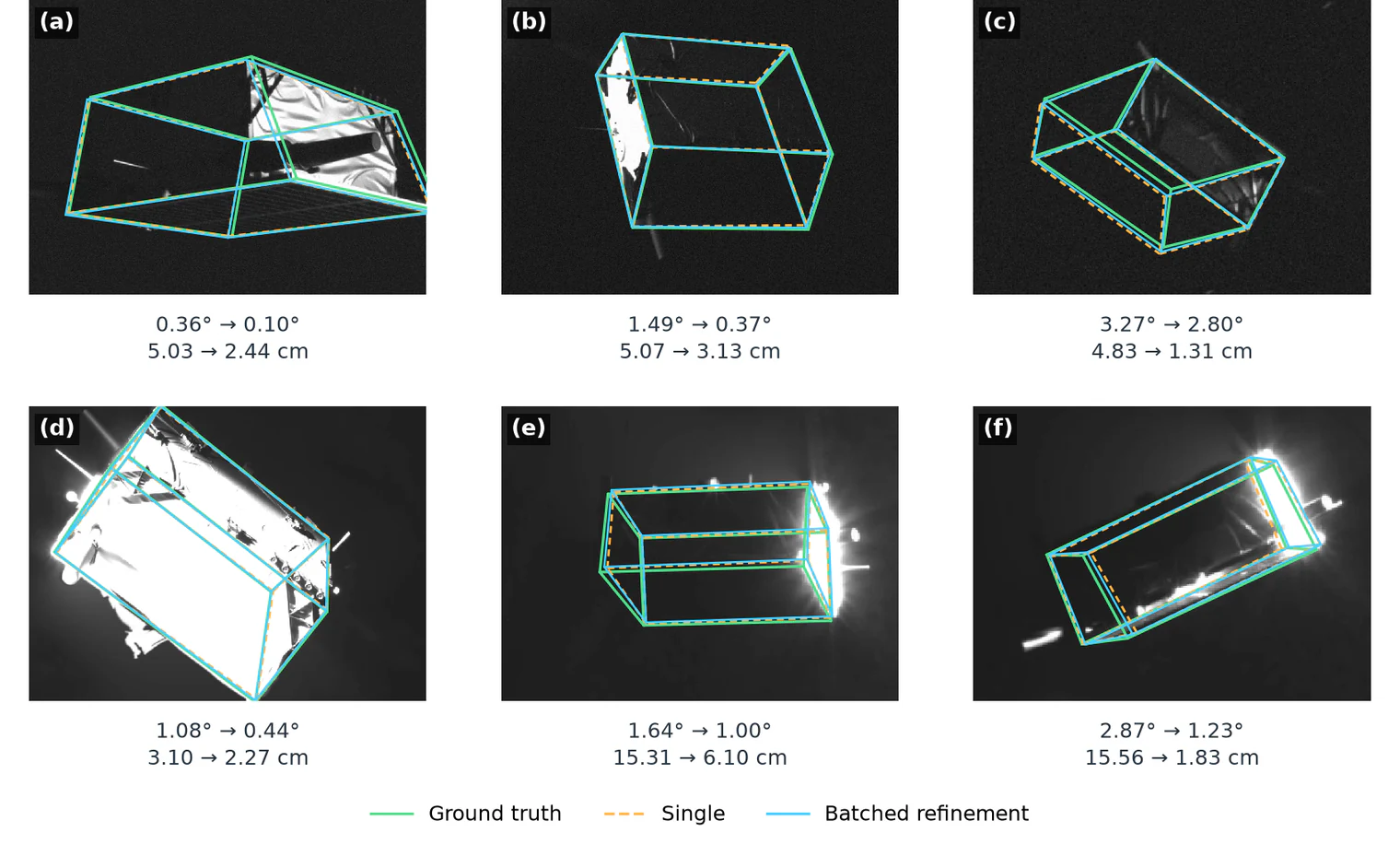
SPEED+ imagery by T. H. Park, M. Märtens, G. Lecuyer, D. Izzo and S. D’Amico. Images were cropped and annotated with pose overlays. Dataset record · CC BY-NC-SA 4.0