Selected researchBraking with delayed thrust
Actuator-preimage braking certificates for terminal spacecraft approach
Spacecraft dynamics · Manuscript, 2026
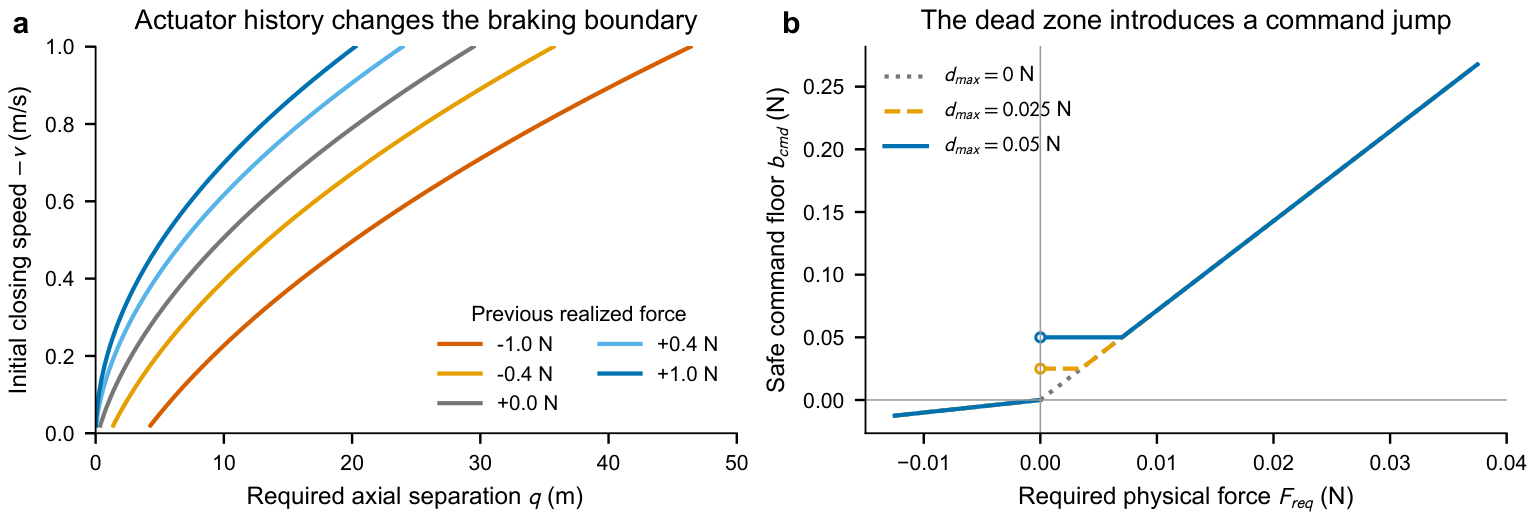
Which commands leave room to stop?
During the last metres of an approach, ordering a thruster to reverse does not reverse the force immediately. The spacecraft may still accelerate toward the target while outward thrust builds. Our filter therefore keeps track of the force already being delivered, alongside separation and closing speed.
At each one-second update, we work backward from a 64-second braking maneuver to find the physical force needed on the next step. We then find the commands that can deliver that force across the assumed range of actuator lag, thrust effectiveness, dead zone and saturation. The filter uses the command closest to the guidance request that still preserves the braking maneuver.
What happens during an approach?
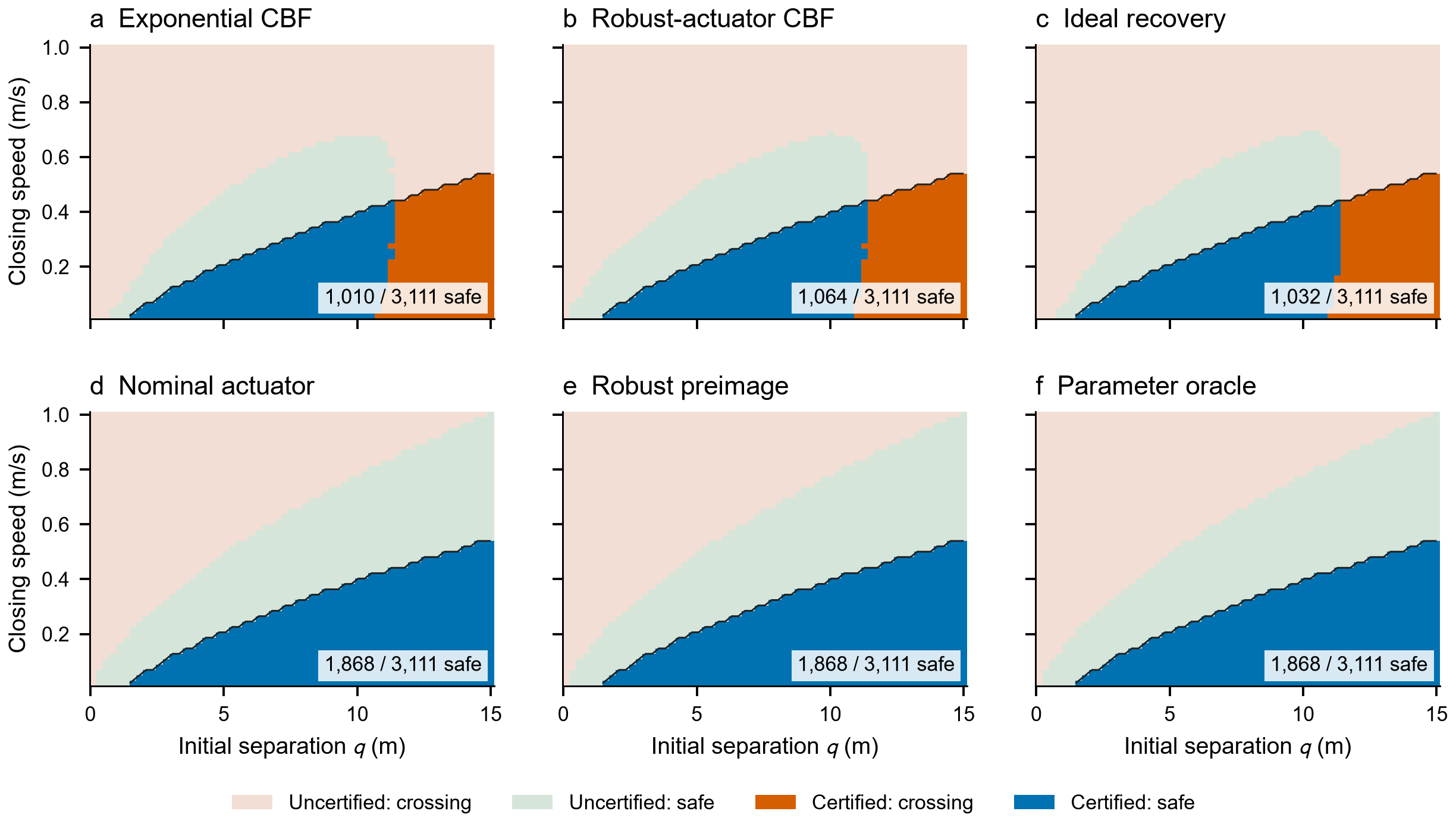
We also simulated thrust building continuously between command updates. Each of five actuator profiles used 4,311 initial states. Across those profiles, all 1,258 initially certified states per profile stayed on the safe side of the plane with the proposed filter. The smallest clearance in those certified runs was 0.484 m.
Outside the certified region, two cases briefly crossed the plane by about 1.9 mm even though their positions looked safe at consecutive command updates. Checking the motion between updates revealed both crossings.